tools
ueCalc
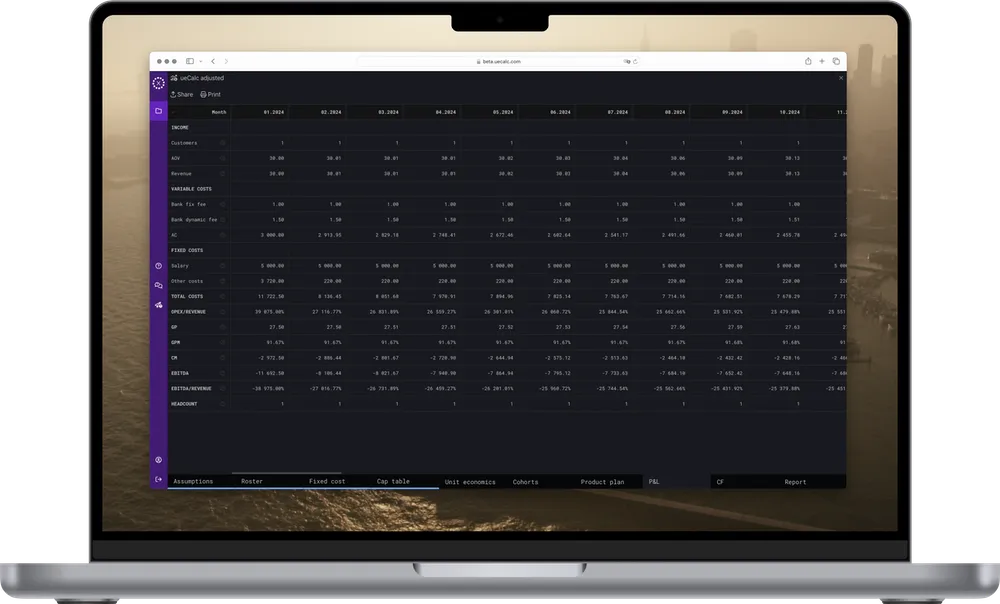
I built ueCalc so any entrepreneur can create a financial model — without a finance degree or Excel. You describe your team's capabilities and business constraints, and ueCalc calculates the optimal metric configuration to hit your target KPIs.
Powered by Goldratt's Theory of Constraints: the system finds metrics where minimal improvement yields the greatest impact on product economics.
10,000+ startups use ueCalc
Features
- Three models: transactional, e-commerce, SaaS
- Unit economics → P&L, Cash Flow, cohorts
- Automatic growth point detection
- Product metrics trees
- Staffing tables, budgets, capitalization table
- Plan/Actual analysis
- Forecasting: exp, sigmoid, complex functions
Pricing
Templates
Free
Pay only for the templates you need — no subscription
- 1 user
- Templates from 10€
- Email support
Start
40€/mo
480€ billed annually
For a business or startup with its own financial model
- 3 users
- All templates free
- Plan-Actual analysis
- Shared team access
- Telegram support
Pro
200€/mo
2400€ billed annually
For consultants, VCs, and accelerators
- Unlimited users
- All templates free
- Plan-Actual analysis
- 24-hour support
Project history
After selling my company Crosss in 2014, I started working with funds and accelerators as a startup consultant. Most of my time was spent promoting unit economics as a decision-making tool in business.
By 2017, it was clear that people wanted a simple tool to calculate marginal profit for their projects. That's how the first version of the script — which would later become ueCalc — was born. It was hosted on this blog and let you enter metric values to get a calculation using Ilya Krasinski's formula.
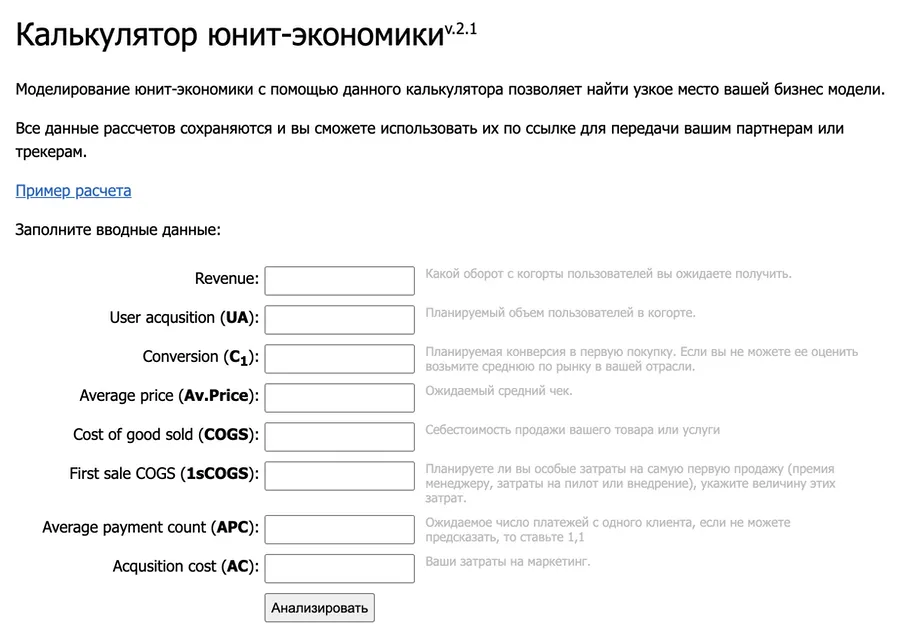
Later I added the ability to save calculations on the server, compute mixed models using the Krasinski-Khanin formula, and find growth points.
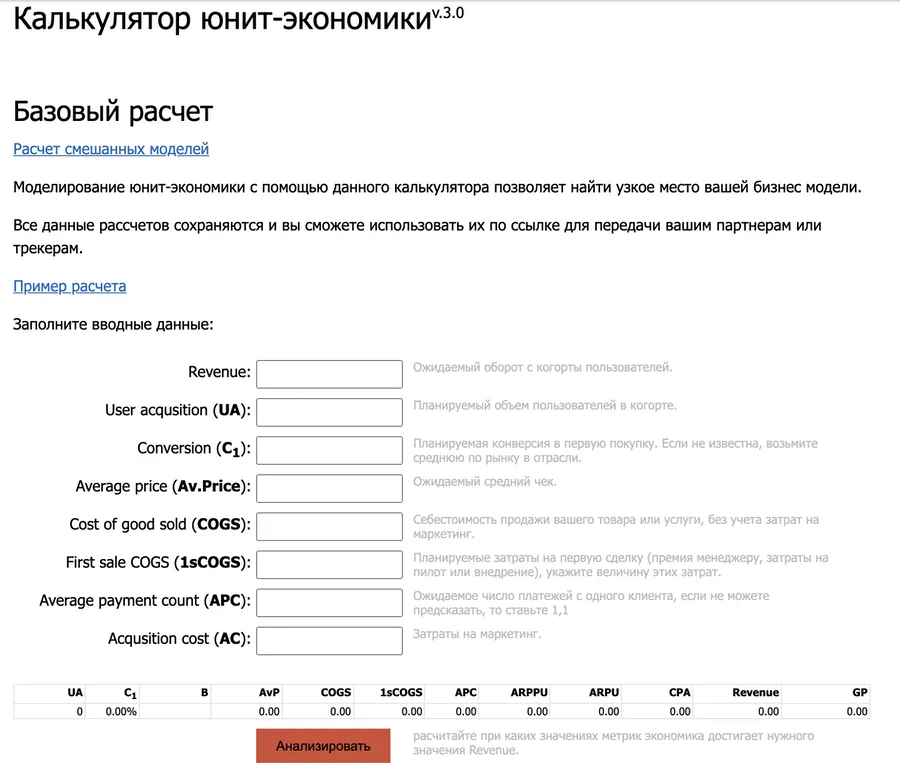
When the number of users exceeded 2,000, I spun the script off into a standalone service. Since then, ueCalc gained the ability to find the optimal metric configuration considering business constraints: market limitations (addressable customers) and competency limitations (team capabilities). Starting with version 6.6, work began on building a full financial model on top of unit economics.
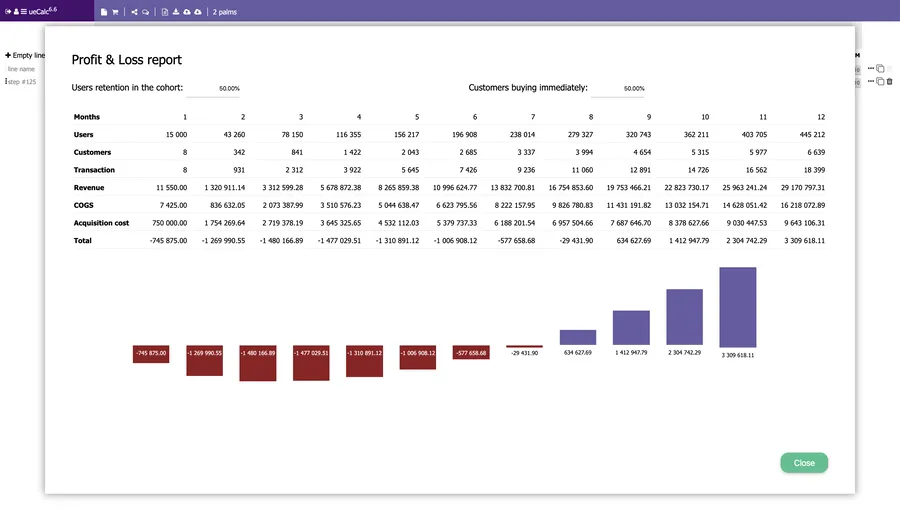
This work culminated in ueCalc.X — the current version that lets you build complete financial models: product plan, P&L, Cash Flow, cohorts, and more.