Discrete Changes in Metrics
When building financial models, I advocate for clear explanations of changes each month in the plan. Often, you open someone else's model and see clients growing uniformly month by month at a fixed percentage, implying linear growth. This is one of the obvious assumptions that is unlikely to be met.

Instead, I suggest using more complex functions, such as exponential or sigmoid, considering seasonal variations, etc. We'll discuss the benefits of such functions another time; today, we'll talk about the need to change metrics discretely, i.e., in jumps at specified periods.
A characteristic example is changing the selling price of a product once a year by the inflation rate. That is, our price does not change throughout the year but changes in January for the entire year and continues like this throughout the plan.
To implement this, ueCalc added a tool for stepwise metric changes. Now, for each model's metric, you can specify four types of change rates: linear—if you know what to do to improve business processes for the metric, exponential and sigmoid for processes requiring a series of experiments to find tools that improve processes, and stepwise for metrics that should change in steps.
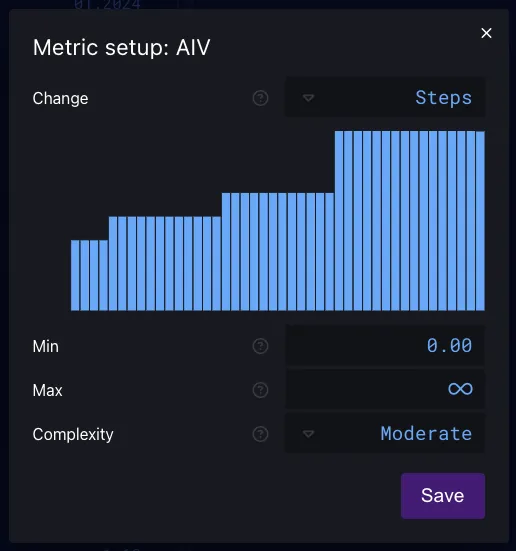
Now, service users can create models that better account for the team's real capabilities to improve business processes described by the model.
Unit economics & financial modeling in practice
50€/year
less than €1/week · billed annuallyPlus: theme customization, font settings, article printing and image zoom.
Subscribe to get access.
If you're already a customer, just log in.
we do not store your email, only the encrypted hash, which increases the security of your email.