10,947 signed up, 90 paid — story of one failure
10,947 people signed up for ueCalc over nine years. 90 ever paid. Total revenue — 6,356€, total investment exceeded 300,000€.
I'm Daniel Khanin. Author of "Unit Economics" with a foreword by Ash Maurya, the creator of Lean Canvas. I teach startups how to do unit economics.
This article is not a complaint and not a motivational "learn from mistakes" post. This is an autopsy. All the numbers, full timeline, every mistake. And at the end — an experiment you can join.
What is ueCalc
ueCalc is a financial modeling tool for startups. P&L forecasts, metrics trees, unit economics — no finance background needed, no 40-tab Excel spreadsheets.
The idea came when I was working with startups from the VC and investor side. I kept running into the same thing: startups can't calculate their unit economics, can't explain their financial model, and sometimes can't even explain how much money they need.
Originally it was a primitive calculator embedded in a website — you enter your unit economics metrics and get a contribution margin calculation using Krasinsky's formula. Below is roughly how it worked.
And here's what it actually looked like:
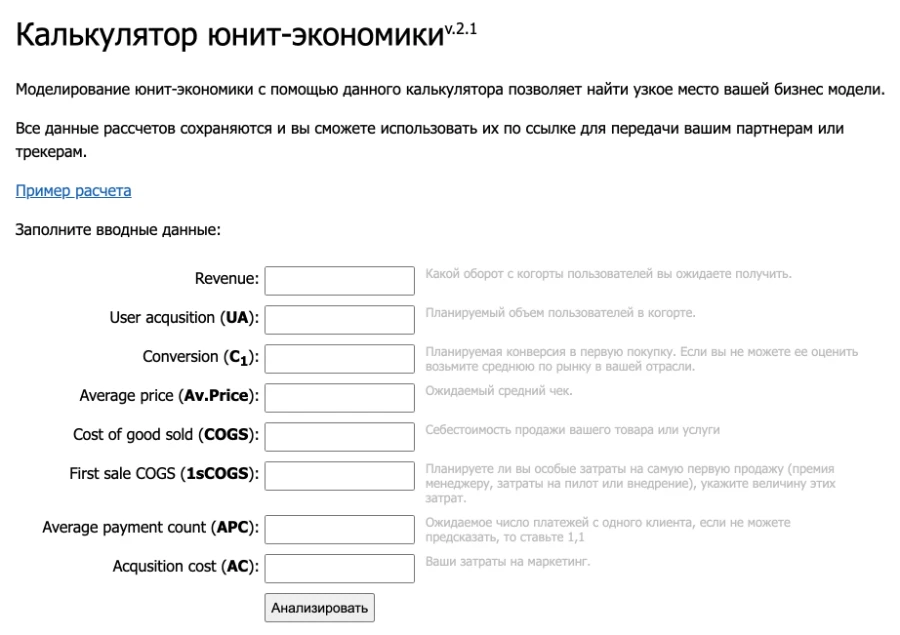
After this calculator was used over 2,500 times, I built a standalone service. The idea was to offer calculations, growth point discovery, optimal configuration, and full financial model building.
Basically, I wanted to turn a simple page on a website into a service with documents, complex features, partially replacing Excel with something of my own, making things simpler for the user.
It started as just a unit economics calculator, but later the product grew into a financial modeling and planning tool that let you build a business financial model based on team competency assessment, using unit economics and Goldratt's Theory of Constraints.
Timeline of a failure
2017 — launch
When ueCalc first launched as a service, I did what SaaS companies do — added a trial period. First two months: 600 signups. I thought it was taking off. But there were no sales. I even wrote an article about it — Trial vs Test drive.1
I decided to kill the trial, which led to a sharp drop in signups. Silence. 10–15 people a month. Three years straight. The product existed, but nobody knew about it. There were some payments, but at roughly the same level as during the trial. Unsatisfactory either way. Unfortunately, I don't have the payment data from before 2024.
2021 — the free experiment
In September 2021 I made a decision that seemed logical: make ueCalc completely free. Remove the barrier. Let people try it, get used to it, and then when I turn payments back on, some of them will stay.
Did it work? Sort of. Signups exploded: 350 a month, then 300, then 250. Fifteen months in a row — hundreds of people every month. About 5,000 people signed up during the free period.
Nice numbers. I went around telling people: "We have 5,000 users." Vanity metric, pure and simple. And I knew it — signups don't equal paying customers. But I still believed people would pay for the service, I just needed to figure out how.
The key problem was that unit economics is not something a business needs on a daily basis. Which means nobody will pay for a subscription. Which is exactly what happened. Throughout 2022, I was trying to figure out how to evolve the product so it would be needed regularly.
2023 — new version, new monetization
In 2023, I decided to pivot to selling templates. I did 20 problem interviews, closed a sale at the end of each one, confirmed that people are willing to pay for financial model templates. I tested prices from 15€ to 3,000€ per template — 50€ turned out to be the sweet spot.
In November 2023 the new version launched, and I turned on monetization right away. Remembering that trials don't work, I set it up so that after registration a user lands in the service and can buy a template — one-time purchase, no subscription needed.
On top of templates, I also added a subscription option for teams and for professional consultants who could create accounts and resell them to their clients.
It all went differently than I expected. Over 2 years, registered users reached 10,947, but I only got 90 paying customers. Technically, since November 2023, 3,133 people registered on the service. Conversion: 3.00%. 69 people bought a one-time template (2.20%) and 21 bought a subscription (0.67%).
Total revenue for the entire period — 6,356€. Over nine years that's 59€ per month from the start, or 219€ per month if you count from November 2023 when the current monetization began.
Today, at the time of writing, active paying customers: 3.
What went wrong
Free attracts the wrong people. They came not because they needed a financial modeling tool — but because it was free. Traffic without intent. When a price appeared, it turned out there was no real need. Just a habit of getting things for free.
Subscription model doesn't fit this kind of tool. A startup doesn't build financial models every day. They do it before a round, before a pitch, at launch. 40€/month for a tool you need three times a year — the math doesn't work. I knew this as a consultant but ignored it as a founder.
I'm a bad salesman. This isn't false modesty, it's a fact backed by nine years of evidence. I can build tools and write about metrics. Explaining to people why they should pay for it — that I can't do. I never wrote a proper landing page, never built an onboarding flow, never set up a funnel. I believed a good product sells itself. It doesn't.
At the same time, over 10,000 people came and signed up on their own. So people do find the product, but either they don't understand how to use it, or it doesn't solve the problem they came for.
The thing is, from talking to customers, I got the impression many of them expected a magic button — press it and everything works. I was simplifying their life by 1000x, but not down to zero. The customer still had to do something themselves.
Sure, today you can ask an AI agent to create an Excel document for you. But the data you need to put into the template — that's still on you. And yes, agents can fill that in too, that's not the problem. The problem is you'll then have to actually execute that plan.
When you solve a hard problem 90% of the way, you need to be smart about selling that solution — because the customer expects 100%.
In the end, I found people who wanted the problem solved. But not people willing to pay for the solution I offered.
Unit economics of a failure
Revenue for the last 29 months (since November 2023 — earlier data is lost): 6,356€ from 90 customers. That's 219€ per month. There were sales before that too, but the numbers can't be recovered.
Revenue breakdown:
Start plan subscription (€50/month): 15 customers
One-time purchases (templates, models): 74 customers
Start plan annually: 480€ — 1 customer
As I expected, one-time purchases attracted 4.5x more people than subscriptions. 74 vs 16. You might think people are willing to pay once but not subscribe — but in reality the cheapest template was 10€, and it looked more like a product test. People tried it, didn't like it or didn't understand what to do, and left.
But most didn't buy anything at all. They wanted to get it for free first, to make sure the product was worth paying for.
When I did solution interviews after launch, I identified two categories of users: those who actually needed a solution — for example, to build a financial model for an investor — and those who just wanted to look around.
Both groups got lost when they opened ueCalc. They didn't understand what to do or how. Partly because they expected magic — open the app, press the "make it good" button, and it's done. But ueCalc is a tool, and you need to use it, know what you want, and enter data.
The first group, those who actually needed it — they figured it out. During solution interviews I just asked them to share their screen and build a model. I sat and watched as my users spent two hours creating a model, learning the product, but ultimately getting a working financial model.
The second group gave up in about 5 minutes. They had no real goal of creating a document, so they had no desire to invest time in learning something new. And this group was the majority.
The main problem was that I wasn't attracting the right audience, or couldn't engage them. I still don't understand what I should have done, and why 10,000 people came but they were the wrong ones. These people did come to the product, they wanted something. But it doesn't matter now. What matters is that the people who needed the product didn't come.
Scaling costs per unit in my model are effectively zero — yes, with business growth that would change, but right now they're zero. So strictly speaking, ueCalc's unit economics are positive.
But for a business to succeed, positive unit economics isn't enough. Contribution margin needs to cover fixed costs. And the company does have fixed costs — minimum monthly expenses to keep the company running are 500€. I'm making 219€. And that's not counting personnel costs. Even just so I could focus 100% on ueCalc, I would need a salary. In fact, since January 2025 I had to leave full-time work on ueCalc and go back to consulting, and then to a regular job.
If you count the cost of just myself over 9 years, I've spent 320,000€ on this project. Seems like a huge amount that brought me no return from the project itself. And that's the minimum estimate — reality is much higher.
A few more numbers: average LTV is 70.62€ per customer. For subscribers, median lifetime is 2 months, then they leave. And honestly, 2 months is probably a mistake — some people just forgot to cancel, then asked for a refund, which made the economics even worse because I lost money on processing fees.
Bottom line: nine years of work, 6,356€ in revenue (strictly speaking, that's over 2 years).
Why subscriptions don't work
Unfortunately, I couldn't come up with a product that people need every day, which means subscriptions don't fit. And in general, lately people have cooled on subscriptions — everyone has dozens of them eating away at their money. Mine just didn't work.
ueCalc is not a SaaS in the classic sense. There's no daily use case. A startup doesn't need a unit economics calculator every day. They need it:
When building their first financial model
When preparing for a pitch
When rethinking strategy
When writing a business plan
That's 3–5 times a year. Pay 40–200€ per month for a tool you use 3 times a year? No sane founder will do that. And they didn't.
The consultant hypothesis didn't work either. The idea was they'd move their work into my service. But it was easier for them to sell their not-so-great Excel models without paying for any service that required learning and additional investment in their own education. Why would they, if things were fine as they were?
I couldn't get through to investors either. On one hand, during interviews and working with them, I saw how unhappy they were with the models startups brought in. On the other hand, nobody was willing to admit they were making decisions essentially at random, and financial models were just a checkbox.
Not a single investor I talked to ended up using the service. Let alone paying. I tried a free trial for investors — that didn't work either. So either I'm a truly terrible negotiator, or investors just don't need to evaluate projects through numbers and prefer gut feeling about the founder and making decisions by intuition.
What's next — finding a new model
I'm not shutting down ueCalc. The product works, it solves the problem. The machine isn't broken — the way I've been trying to sell it is. So I decided to change the monetization model and find a way to bring money into the project.
Here are the models I'm considering:
Lifetime deal — pay once, use forever
Instead of a 40€/month subscription — a one-time purchase. A startup doesn't need ueCalc every month, but does need it long-term. "Buy it and it's yours" — that's more honest than a subscription for a tool you use 3 times a year.
The tool stays cloud-based though, so I can't guarantee it runs forever. So buying once and for all means a guarantee of at least one year of access from purchase, with all updates within the minor version included.
A new major version would need to be paid for separately. But this is just a hypothesis, and maybe things will turn out differently.
Bundle with expertise
ueCalc by itself is a tool. But a tool without context is useless. What if instead of selling a calculator, I sell a package: ueCalc + financial model templates + my articles on how to calculate + the right to ask me a question? Not a software subscription — an expertise subscription, with software included.
I even tried launching something like this. Some templates had a link — request a consultation. Nobody clicked it. Maybe they just didn't see it. Also, paying for a consultation on top of a subscription felt weird. Either way, I didn't think this through.
New marketing
Honestly, knowing that sales is my weak point, it seems right to change exactly that part — and that means I need to start selling. In startup circles, people say the founder has to sell the product in the beginning. And that's exactly what I can't do.
I tried different approaches — brought in partners, gave them a significant share, but nobody stayed. I never got offers from people willing to sell the product. And you'd have to start from zero — there's no marketing budget.
I also tried using an LLM for promotion — we built a content plan, wrote posts for popular platforms, where I got banned almost immediately. And no results came out of it anyway.
What else I tried: regular posting. Last year for 100 days straight I published a short note in Russian, English, and Spanish across 12 channels (Telegram, WhatsApp, LinkedIn, Facebook, blog, etc.) — zero effect. But at least a nice cards section appeared on the website.
Open question
I don't know which model is right. Nine years of evidence that my sales intuition doesn't work. So I'm asking you.
What bothers me is this: I did problem interviews and even closed sales during them, but after launching — no sales. Also, I realize that even now I'm trying to build the experiment around the product, not around improving marketing, which seems extremely inefficient, like roulette. If I'm lucky, I'll get to talk about how great I am and what a brilliant move I made. But most likely it'll be another failure.
I also keep in mind the option of just shutting the project down. But I'll say upfront — I'm not looking for "just close it" advice. My goal is to learn how to market. I can always close it later.
Public experiment
I'll be looking for a new model in the open. Every step I'll publish here, on khanin.info. Real numbers, real decisions. If I mess up again — you'll see exactly how, and we'll figure out together what went wrong.
And I need your help.
In May, everyone who subscribes to khanin.info gets everything I've built:
khanin.info premium — articles, podcasts, book, Metrics Tree Studio, direct questions to me
Subscribers can comment on articles, share advice and opinions, essentially take part in the development.
loOom — graph navigator for structured data and working with AI agents.
All financial model templates — SaaS financial model, E-commerce with stochastic returns, and more.
All together worth 770€+. You pay 50€.
I don't need 10,947 signups. I need 50 people who will actually try ueCalc and tell me: this doesn't work, this is useless, but I'd pay for that. Or those 50 people will tell me I should just do something else entirely.
Why 50 people? Honestly, I want more — my internal target is 1,000 subscribers. But to understand how marketing works, what people actually care about, and how this whole thing functions, I'm starting with the first 50.
First 50 people. Before May 31. After subscribing, write to me — I'll personally activate your ueCalc access.
This is the first article of the experiment. Next one: May results, first feedback, first decisions on the new model. Subscribe so you don't miss it.
Unit economics & financial modeling in practice
50€/year
less than €1/week · billed annuallyPlus: theme customization, font settings, article printing and image zoom.
Subscribe to get access.
If you're already a customer, just log in.
we do not store your email, only the encrypted hash, which increases the security of your email.